|
Electroneurodiagnostic Technology, AAS Degree
Electroneurodiagnostic (END) Technologists record and study the science of the electrical activity of the brain and spinal activity. Working with both doctors and patients,
END technologists develop a good rapport with patients, comforting them during procedures. They understand neurophysiology and recognize normal and abnormal electrical activity. Electroneurodiagnostic Technologists are responsible for preparing patients for procedures such as Electroencephalograms (EEG), Polysomnograms (PSG), and Evoked Potentials (EP). END Technologists obtain medical histories of patients, record electrical potentials, calculate results of tests, maintain medical equipment, and may work with specific treatments.
Clinical Affiliation: Students will be placed in a clinical affiliation for 7 months in medical centers throughout the United States. If a student does not complete specialty ENDT classes in three consecutive semesters, faculty and administration will determine whether courses must be repeated before enrolling in clinical. Clinical placement is determined only after the student has been observed safely and consistently performing all required procedures in specified time frames.
|
|
|
Semester |
Course Title |
|
|
|
|
Summer & First Semester
|
|
|
Chemistry Survey |
4 |
Students who have had some chemistry and those who have had no chemistry background will acquire a basic understanding of the makeup of matter and the changes that it undergoes. Going from simple elements to complex compounds, this course will be concentrating on some observational facts and theoretical concepts involving problem solving, scientific reasoning, thinking and "wondering why". |
|
|
Computer Essentials |
2 |
Designed to enable students with little or no computer experience to acquire a basic understanding of the personal computer. This course involves the study of computer basics such as hardware, operating systems, and file management, using the Internet for research, word processing, and spreadsheets. |
|
|
Introduction to EEG |
2 |
Provides an introduction to basic electroencephalographic (electro = electrical, encephalo = brain, graph = chart) recording techniques. History of EEG, clinical indications and usefulness are covered. By placing of electrodes on the scalp, amplifying the electrical signal and recording this activity through the skull, a basic EEG is performed. Emphasis is placed on a fundamental understanding of the electrical activity produced by the brain and the recording techniques used to monitor this activity. This course includes an overview of recording techniques including analog and digital, international standards of electrode placement, recording length, electrical resistance, and electrical safety. |
|
|
Basic Electricity |
3 |
Provides instruction in atomic theory/charge, voltage, current, resistance, power, AC/DC, capacitance, inductance, elements in series and parallel, impedance, time constraints, transformers, semiconductors (diodes, transistors/amplifying devices, and digital devices). |
|
HC 119
HC 119 |
Anatomy/Physiology |
5 |
| HC 119L |
Anatomy/Physiology Lab |
|
| HC 117 |
Medical Terminology |
1 |
|
|
Patient Care Techniques I |
3 |
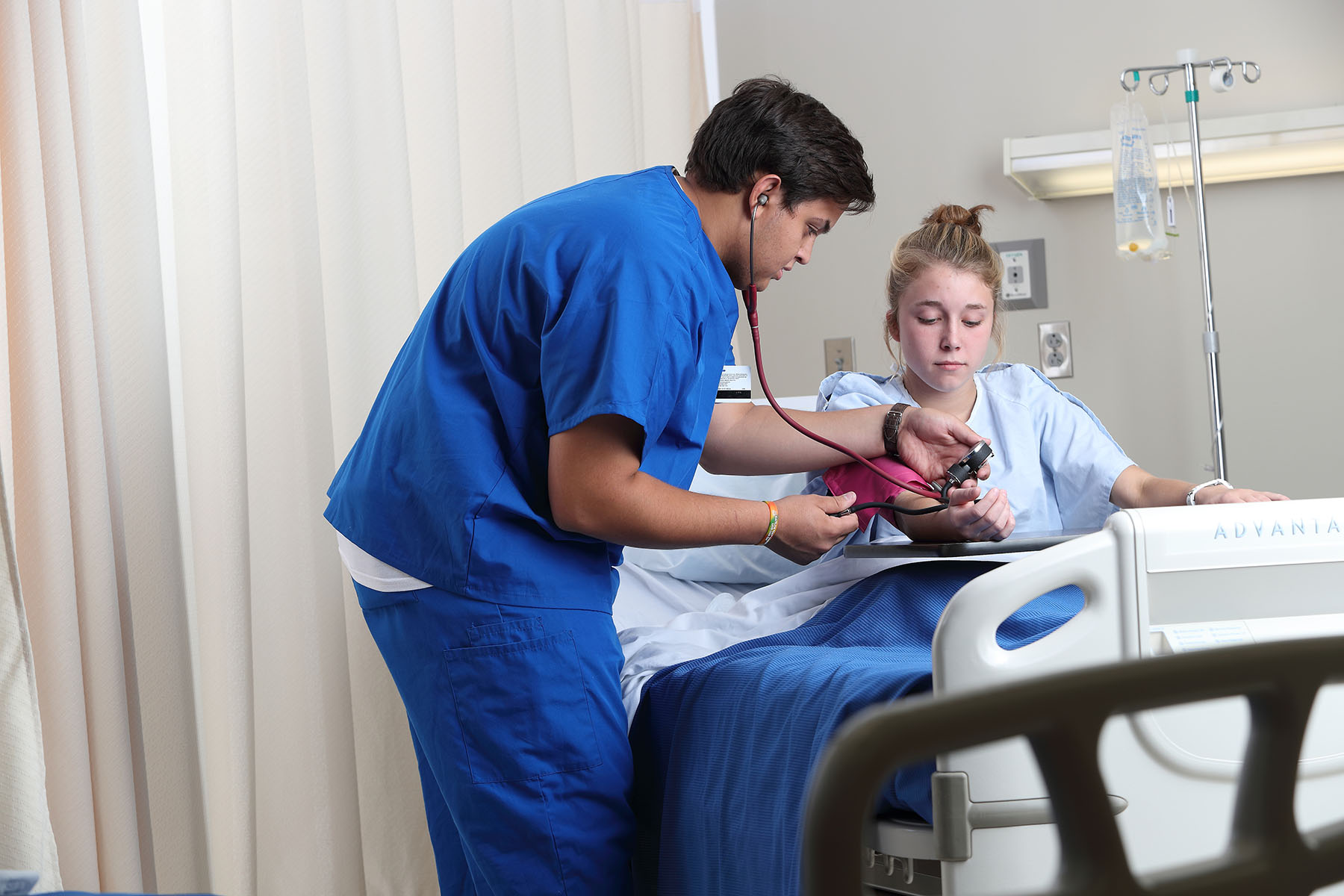
Designed to assist students in developing the necessary skills to directly deal with patients. Skills acquired will help protect themselves, as well as the patient, and includes infection control, body mechanics, vital signs, CPR/First Aid, dealing with tubes and equipment, safety and security as well as other topics. |
|
|
Intermediate Algebra |
4 |
This algebra course begins with real numbers, absolute values, exponents, polynomials, and the factoring of trinomials. Then, first and second-degree equations and applications are studied. Skills in simplifying arithmetic expressions and calculating and solving rational expressions are covered. Exponents, radicals, complex numbers, second-degree equations, graphing, and systems of linear equations will be included. Prerequisite: Placement Assessment. |
|
|
|
Second Semester
|
|
|
Applied Electronics and Instrumentation |
2 |
Includes electronics and instrumentation associated with the conventional electroencephalograph; the power supply contribution of electrodes, differential amplifier concepts, filters (low frequency, high frequency and 60 hertz filter), the writer unit, electrical output, electrical safety and standards for clinical electroencephalographs. Also covers ambulatory monitoring and digital electroencephalography. Prerequisite: ENDT 110 |
|
|
Electroneurodiagnostic Tech Science |
5 |
Provides theory and application of electrical concepts, recording techniques, data analysis and description. The electrical signals from the brain are in a constant flux. These variations occur in two dimensions: time and amplitude. Time is expressed in cycles per second or herz. Amplitude is an index of voltage. Students will learn recording techniques, standard machine settings, when changing these settings may be indicated, data analysis, recognition of spikes, sharp wave verses slow waves, and wave form description, i.e., there is phase reversing spike at 100uV amplitude over the left anterior temporal convexity. Prerequisites: HC 111, ENDT 100 |
|
|
Electroneurodiagnostic Clinical Science I |
2 |
Introduces the student to electroneurodiagnosis, neurophysiology, functional neuroanatomy, normal and abnormal conditions and correlates. Includes electroencephalographic signs of cerebral disorders. Recognition of normal brainwave patterns, normal variants, abnormal patterns and how these correspond in general to disease entities will be discussed. Prerequisites: HC 111, ENDT 100 |
|
|
Polysomnography I |
3 |
Includes fundamental and detailed study of the various sleep disorders, their symptoms, consequences, treatments, and polysomnographic manifestations. Sleep stage scoring, pattern recognition and data computation are covered. Instruction in patient examination and history taking for sleep disorders is covered. |
|
SOC |
Social Science Elective: ECON 201 T-Economics SOC 150T- Social Problems, or SOC 250T- Marriage and the Family. |
3 |
|
|
Health Care/Human Relations |
3 |
Discussions and activities will center around the topic of respect. This course introduces students to health care issues and assists them in developing personal and employability success skills. Topics include, but are not limited to: accountability, professionalism, communication, confidentiality, patient rights, cultural bias and discrimination, effective interpersonal skills, dealing with difficult patients of all ages, and death and dying issues. |
|
|
|
Summer Session I
|
|
|
Evoked Potential I |
2 |
Introduction to the three modalities of evoked potentials; brainstem auditory, visual and somatosensory, as well as EP history, signal averaging, statistics, A/D converter, amplifiers, filters and various stimulators used for each modality. Lab sessions include electrode placement, stimulator set-up and recording of evoked potentials using volunteers. |
|
|
Composition |
3 |
English Composition will help develop proficiency in writing concise, coherent essays, and in using correct English. Several modes of discourse will be explored and good grammar skills are required. This course will improve the student's critical thinking skills as it provides students with practice in all stages of the writing process: planning, supporting, rewriting, analyzing, proofreading, and editing. This course will also require critical reading and writing. Prerequisite: Placement Assessment |
|
|
General Psychology |
3 |
Provides the student with an introduction to the basic psychological processes underlying human behavior. Topics include the functions of the brain amd nervous system, the characteristics of sensation, perception and altered states of consciousness, learning and memory, the nature of thinking skills and intelligence, theories of motivation, emotion and personality, a survey of psychological disorders and approaches to therapy, social/interpersonal relations, and practical applications. |
|
|
|
Third Semester
|
|
|
Evoked Potential II |
3 |
In depth study of all three modalities; somatosensory uses in clinical and intraoperative monitoring; brainstem auditory evoked potentials and evaluation of the auditory pathway; and visual evoked potentials and the evaluation of the visual pathway. Specific structural and disease entities and their effect on evoked potential responses. Establishment of laboratory standards including normal values using statistical means, and standard deviations. Prereq ENDT 200. |
|
|
Electroneurodiagnostic Clinical Science II |
3 |
Studies specific neurological disease entities; stroke, tumor, encephalopathies, as well as seizure disorders and corresponding EEG patterns. This will include triphasic waves, three per second spike and wave, and localizing dipoles. Introduction to EEG in carotid endartectomies, epilepsy monitoring, and EEG monitoring during epilepsy surgery. Prereq ENDT 123 |
|
|
Polysomnography II |
3 |
Hands-on experience and instrumentation theory of various polysomnographic recording equipment utilized for recording polysomnographic studies and includes patient hookup, calibration and simulated testing in the lab. Continuous positive airway pressure and oxygen titration will be demonstrated. Prereq ENDT 124 |
|
|
Electroneurodiagnostic Clinical I |
1 |
Focuses on clinical application of basic EEG techniques according to lab protocol. This includes interviewing of patients for history, measuring the scalp for electrode placement, impedance test, proper filter setting and calibration of equipment under direct supervision of staff. Record review with physicians and correlative seminars are included. Coreq ENDT 210, ENDT 230 |
| ENDT 121 |
Homeostatic Physiology |
3 |
|
|
Technical Writing |
3 |
This course is designed around workplace writing tasks. Students will learn to evaluate audience, solve problems, and develop strategies for writing collaboratively. They will write instructions, reports, memos and letters. The course emphasizes techniques for correct mechanics and clear style; using format effectively to improve document readability; choosing and designing visuals for audience; and managing time and multiple projects. Prerequisite: ENGL 101 |
|
|
Basic Pharmacology |
2 |
Observing, testing, treating and administering to the countless requirements and demands that constitute effective and responsible patient care; this course introduces pharmaceuticals according to their therapeutic applications and pertinent physiology, and related diseases. Emphasis is placed on pharmaceutical classification concentrating on the mechanism of action, main therapeutic effects, and the adverse reactions produced. Prerequisite: HC 111 |
|
|
|
Fourth Semester
|
|
|
Electroneurodiagnostic Clinical II |
16 |
Provides continued clinical recording techniques including a broad patient population and procedure range. May also include clinical time in a Polysomnography setting. Prereq ENDT 240 |
|
|
|
Summer Session II
|
|
|
Electroneurodiagnostic Clinical III |
12 |
Provides clinical practice in performing electroencephalograms, evoked potentials, operating room, epilepsy monitoring, sleep studies using appropriate techniques according to protocol. Prereq ENDT 250 |
|
|
|
|
|
|