|
Semester |
Course Title |
|
|
|
|
Program Prerequisite
|
|
|
College Algebra |
3 |
This is a first year, one semester College Algebra course. It begins with a review of the fundamental concepts of the real number system, polynomials, factoring, rational expressions and complex numbers. It continues with linear equations and inequalities, graphs of functions, polynomial and rational functions, exponential functions and logarithmic functions. Systems of equations, matrices and determinants, and probability will be covered as time allows. Throughout the course there is extensive use of the graphing calculator. Prerequisite: Placement Assessment |
|
Summer/First Semester
|
|
|
Chemistry Survey |
4 |
Students who have had some chemistry and those who have had no chemistry background will acquire a basic understanding of the makeup of matter and the changes that it undergoes. Going from simple elements to complex compounds, this course will be concentrating on some observational facts and theoretical concepts involving problem solving, scientific reasoning, thinking and "wondering why". |
| CHEM 106L |
Chemistry Survey Lab |
|
|
|
Computer Essentials |
2 |
Designed to enable students with little or no computer experience to acquire a basic understanding of the personal computer. This course involves the study of computer basics such as hardware, operating systems, and file management, using the Internet for research, word processing, and spreadsheets. |
|
|
Intro to Cardiovascular Ultrasound |
1 |
An introduction into the field of cardiovascular ultrasound will look at the history of ultrasound and the role a sonographer plays in the diagnosis of cardiovascular problems. A basic knowledge of cardiovascular anatomy, terminology, ultrasound principles, and ethics will be covered. |
|
|
Vascular History & Physical |
1 |
This is a comprehensive study of the role of the Vascular Ultrasound Technologist in obtaining a patient history and physical exam. This will include understanding risk factors, signs and symptoms, and physical examination for the various diseases associated with the vascular systems. The student could be exposed to speakers presenting on cardiovascular technology and Vascular Ultrasound. Some of these may be by attending outside activities such as: cardiovascular in-service by local hospitals |
|
|
Composition |
3 |
English Composition will help develop proficiency in writing concise, coherent essays, and in using correct English. Several modes of discourse will be explored and good grammar skills are required. This course will improve the student's critical thinking skills as it provides students with practice in all stages of the writing process: planning, supporting, rewriting, analyzing, proofreading, and editing. This course will also require critical reading and writing. Prerequisite: Placement Assessment |
|
HC 119
HC 119 |
Anatomy/Physiology |
5 |
The study of the structure and function of the human body forms the foundation for course work in health-related professions. Students will be prepared to recognize normal anatomy and physiology while noting anatomical as well as physiologic deviations in patients. This course includes a rigorous study of medical terms/abbreviations, correlating with each body system, thus assisting the development of a vocabulary which is necessary for a successful career in allied health. |
| HC 119 |
Anatomy/Physiology Lab |
|
| HC 117 |
Medical Terminology |
1 |
|
|
Patient Care Techniques I |
3 |
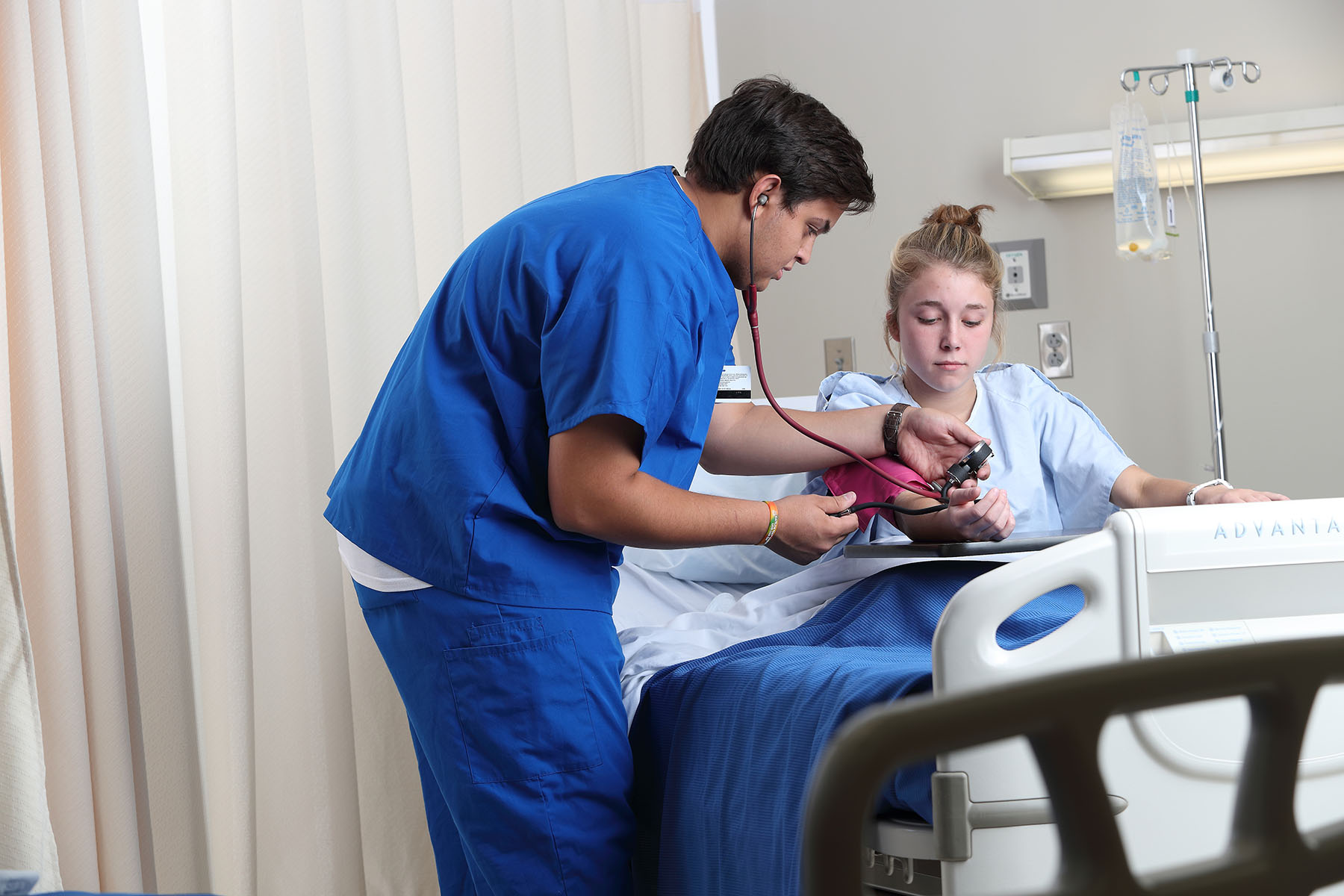
Designed to assist students in developing the necessary skills to directly deal with patients. Skills acquired will help protect themselves, as well as the patient, and includes infection control, body mechanics, vital signs, CPR/First Aid, dealing with tubes and equipment, safety and security as well as other topics. |
| HC 121L |
Patient Care Techniques I Lab |
|
|
|
Applied Physics |
3 |
A foundation to understanding physical processes in technical applications. A thorough overview of measurement systems, practices, and notations is presented. Energy transformation and transfer processes are developed using a "systems model." Physical processes are then described using the systems approach in a "micro-to-macro" sequence, including atomic/nuclear, molecular, electrical/magnetic, mechanical, thermal, fluid, wave/radiating, and optional astronomic/cosmic effects. Definitions and descriptions of the mass/energy interactions involved are given for each type of system, leading toward diagnosis and troubleshooting methods in technical applications. |
|
|
|
Second Semester
|
|
|
Ultrasound Physics |
3 |
Students will be introduced to the principles of ultrasound physics and instrumentation. Emphasis will be placed on parameters of sound waves, interaction of sound and media, transducers, artifacts, safety, and quality assurance. Students will also become familiar with metric units, sound beams, types of resolution, display modes and scan converters. Prerequisite: PHYS 100 |
|
|
EKG Interpretation |
2 |
Students will be introduced to the electrophysiology of the heart and basic principles of EKG interpretation and the concepts essential in the recognition of cardiac arrhythmias. Students will become familiar with EKG, stress testing and Holter monitoring equipment. (Prerequisite: CV 101, CVP 102) |
| CVP 120L |
EKG Interpretation Lab |
|
|
CVP 124
CVP 124 |
Vascular Hemodynamics |
3 |
Class focuses on the physiology and hemodynamics of blood flow within the arterial and venous systems throughout the body. Characteristics of flow to be discussed will consist of: potential and kinetic energy, resistance, pressure, velocity, volumetric flow, energy gradients, Poiseuille’s Law, Bernoulli’s Equation, types of flow characteristics, and Reynolds Number. (Prerequisites: Core, CV 101, CVP 102) |
|
CVP 123L
CVP 123L |
Vascular Hemodynamics Lab |
1 |
Lab focuses on the physiology and hemodynamics of blood flow within the arterial and venous systems throughout the body. The student will be introduced to spectral and color Doppler instrumentation while scanning the vascular anatomy and how it is used to evaluate blood flow. Students will practice on fellow students during and outside of lab for assigned lab projects. (Corequisite: CVP 124) |
|
|
Vascular Anatomy |
2 |
This is a comprehensive study of the role of the Vascular Ultrasound Technologist. A thorough knowledge of vascular anatomy to include the heart, central, peripheral, and cerebral arterial system, venous system, and microscopic anatomy will be covered. The student will also look at perspective anatomy by the use of ultrasound and identify anatomy in both sagittal and transverse planes. The student may also be exposed to speakers presenting on cardiovascular technology and Vascular Ultrasound. Some of these may be by attending outside activities such as: cardiovascular in-service at local hospitals. (Prerequisite: Core, CV 101, CVP 102) |
|
|
Vascular Anatomy Lab |
1 |
This course will assess vascular anatomy as seen on ultrasound. This will include anatomy and surrounding structures of the peripheral arterial and venous anatomy of upper and lower extremities and cerebrovascular anatomy. Anatomy will be viewed on both transverse and sagittal planes During the Vascular Ultrasound Lab the student will be offered hands on experience practicing on fellow students. Emphasis will be placed on ultrasound imaging and the identification of vascular anatomy. The student will also be exposed to other non-invasive techniques in evaluating vascular system such as, taking blood pressures, plethysmography; directional and hand held Doppler's. The student may also be exposed to speakers presenting on cardiovascular technology and Vascular Ultrasound. This could include going to local hospitals. (Corequisite: CVP 136) |
|
|
Health Care/Human Relations |
3 |
Discussions and activities will center around the topic of respect. This course introduces students to health care issues and assists them in developing personal and employability success skills. Topics include, but are not limited to: accountability, professionalism, communication, confidentiality, patient rights, cultural bias and discrimination, effective interpersonal skills, dealing with difficult patients of all ages, and death and dying issues. |
|
|
Basic Pharmacology |
2 |
Observing, testing, treating and administering to the countless requirements and demands that constitute effective and responsible patient care; this course introduces pharmaceuticals according to their therapeutic applications and pertinent physiology, and related diseases. Emphasis is placed on pharmaceutical classification concentrating on the mechanism of action, main therapeutic effects, and the adverse reactions produced. Prerequisite: HC 111 |
|
|
|
Summer
|
|
|
Vascular Pathophysiology |
3 |
This is a comprehensive, critical thinking course that entails cerebrovascular pathophysiology and how it affects the physiology of blood flow. A variety of cerebrovascular pathologies will be discussed and how it affects patient H&P, which type of vascular testing needs to be performed, hemodynamics, and imaging. A look at non-invasive and invasive treatments will also be discussed. Critical thinking skills will be used to put information together from all CVP classes. The student may also be exposed to speakers presenting on cardiovascular technology and Vascular Ultrasound. Some of these may be by attending outside activities such as: cardiovascular in-service at local hospitals. (Prerequisite: CV 123, CVP 120, 124, 123, 136, 137) |
|
|
Vascular Pathophysiology I Lab |
1 |
During this lab course, students will continue to perfect their scanning skills in various cerebrovascular tests. This lab will continue to further their skills in preparing themselves for their clinical rotation by completing full exams, with accuracy, and time limitation in which to complete exam. Students will practice on fellow students during and outside of lab for assigned lab projects. (Corequisite: CVP 210) |
|
|
Social Science Elective |
3 |
Social Science Electives Include: ECON 201T - Economics; SOC 150T - Social Problems; or SOC 250T - Marriage and the Family |
|
|
Fundamentals of Speech |
3 |
Based on the study of communication theory as applied to public speaking. The goals are to improve the student's public speaking and listening skills. Experiences in the class range from developing speech outlines, researching topics, and practicing delivery techniques for an informative, persuasive, interviewing techniques and panel discussion assignment. |
|
|
|
Third Semester
|
|
|
Cardiovascular Physiology |
3 |
Provides the core of information and concepts necessary to develop a firm understanding of how the cardiovascular system operates. Emphasis is placed on cardiac structure, cardiac electrical activity, cardiac pumping action and the clinical indices of ventricular function. Students will be introduced to coronary blood flow, fetal circulation, and pathophysiology of cardiovascular disease states. Prerequisites: CV 122, CVP 124 , CVN 124 or CVI 210 |
|
|
Cardiac Pathologies |
3 |
An introduction to pathological, clinical and investigative aspects of heart disease. Students will be introduced to the following topics; heart sounds, diagnostic imaging and invasive procedures, electrocardiogram, atherosclerosis, ischemic heart disease, acute MI, valvular heart disease, heart failure, cardiomyopathies, hypertension, pericardial disease, peripheral vascular disease, congenital heart disease, and cardiovascular drugs. Prerequisites: CV 122, CVP 124, CVN 124 or CVI 210 |
|
|
Applied Vascular Ultrasound Physics |
1 |
Applied vascular ultrasound physics will focus on the preparation for the vascular ultrasound physics portion of the national certification examination. Activities are designed to review ultrasound physic principles, vascular hemodynamics as they relate to vascular physics and other vascular physical principles. Prerequisite: CVP124 & CVP124L |
|
CVP 126L
CVP 126L |
Applied Vascular Ultrasound Physics Lab |
1 |
Applied vascular ultrasound physics lab covers vascular testing involving the use of a variety of plethysmography techniques such as air plethysmography and photo plethysmography. Students will practice on fellow students during and outside of lab for assigned lab projects. Corequisite: CVP125 |
|
|
Vascular Pathophysiology II |
3 |
This is a comprehensive, critical thinking course that entails peripheral arterial and venous pathophysiology and how it affects the physiology of blood flow. A variety of arterial and venous pathologies will be discussed and how it affects patient H&P, which type of vascular testing needs to be performed, hemodynamics, and imaging/nonimaging. A look at non-invasive and invasive treatments will also be discussed. Critical thinking skills will be used to put information together from all CVP classes. The student may also be exposed to speakers presenting on cardiovascular technology and Vascular Ultrasound. Some of these may be by attending outside activities such as: cardiovascular in-service at local hospitals. (Prerequisites: CVP 210, CVP 211) |
|
|
Vascular Pathophysiology II Lab |
1 |
During this lab course, students will continue to perfect their scanning skills in various peripheral arterial and venous tests. This lab will continue to further their skills in preparing themselves for their clinical rotation by completing full exams, with proficiency, and time limitation in which to complete exam. Students will practice on fellow students during and outside of lab for assigned lab projects. (Corequisite: CVP 214) |
|
|
Abdominal Vascular Ultrasound |
2 |
Study of anatomy, physiology, pathology and pathophysiology of the abdominal cavity, peritoneal cavity to include: Aorta, Endovascular Aortic Aneurysm Repair, Iliac, IVC, Mesenteric vasculature, renal vessels and allografts, portal and hepatic vasculature as visualized by ultrasound. Doppler and color Doppler application will be applied to the anatomy. Prerequisite: (CVP 210, CVP 211L) |
|
|
Abdominal Vascular Ultrasound Lab |
1 |
Applying knowledge and scanning skills of anatomy, physiology, pathology and pathophysiology of the abdominal cavity to include: aorta, endovascular aortic aneurysm repair, iliac, IVC, mesenteric vasculature, renal vessels and allografts, hepatic vasculature, and male genitalia as visualized by ultrasound. Doppler and color Doppler application will be applied to the anatomy. (Corequisite: CVP 220) |
|
|
General Psychology |
3 |
Provides the student with an introduction to the basic psychological processes underlying human behavior. Topics include the functions of the brain amd nervous system, the characteristics of sensation, perception and altered states of consciousness, learning and memory, the nature of thinking skills and intelligence, theories of motivation, emotion and personality, a survey of psychological disorders and approaches to therapy, social/interpersonal relations, and practical applications. |
|
|
|
Fourth Semester
|
|
|
Vascular Ultrasound Clinical I |
14 |
A full-time clinical internship completed at an affiliated local or out-of-town hospital or clinic. Students will broaden and perfect their peripheral vascular skills through active hands-on participation in a noninvasive cardiovascular laboratory. They will be exposed to and receive intensive training in many of the various procedures performed in the vascular lab. Prerequisites: All CV, HC, CVP, General Courses and Permission of Program Chair |
|
|
Vascular Registry Review |
2 |
This course is conducted on the STI campus during the week of spring graduation. Students will participate in review of program course content, clinical findings and expectations, and registry preparation testing and activities. Students will present current clinical case studies and share clinical experience summaries. Student clinical portfolio review and analysis will also be conducted. (Corequisite: CVP 233) |
|
|
|
Summer
|
|
|
Vascular Ultrasound Clinical II |
12 |
This course is a continuation of CVP 233 which is a full time clinical internship (40 hours / week) and will be completed at the same location. Students will broaden and perfect their vascular ultrasound skills. Emphasis is placed on critical thinking skills as related to exam performance and patient care settings. The student will also complete coursework and portfolios during the clinical internship. (Prerequisite: CVP 233, CVP 255 and permission of the Program Chair) |
|
|
|
|